Use limestone slurry density as a process measurement, not an isolated number
Limestone slurry density can support dilution, solids handling, grinding, transfer and reagent preparation decisions. The reading is useful only when the stream, operating range and action are clearly defined. Particle size, entrained air, settling, temperature and changes in liquid or solids composition should be considered during location selection and commissioning.
Continuous density visibility
A non-nuclear ultrasonic slurry density meter can provide frequent process data from a full pipe. The measurement can complement laboratory or at-line checks and help operators see changes sooner.
Density and solids are not identical
A conversion from bulk slurry density to solids concentration depends on the densities of the solid and liquid phases and on a stable composition basis. State the required output and assumptions before configuring calculations.
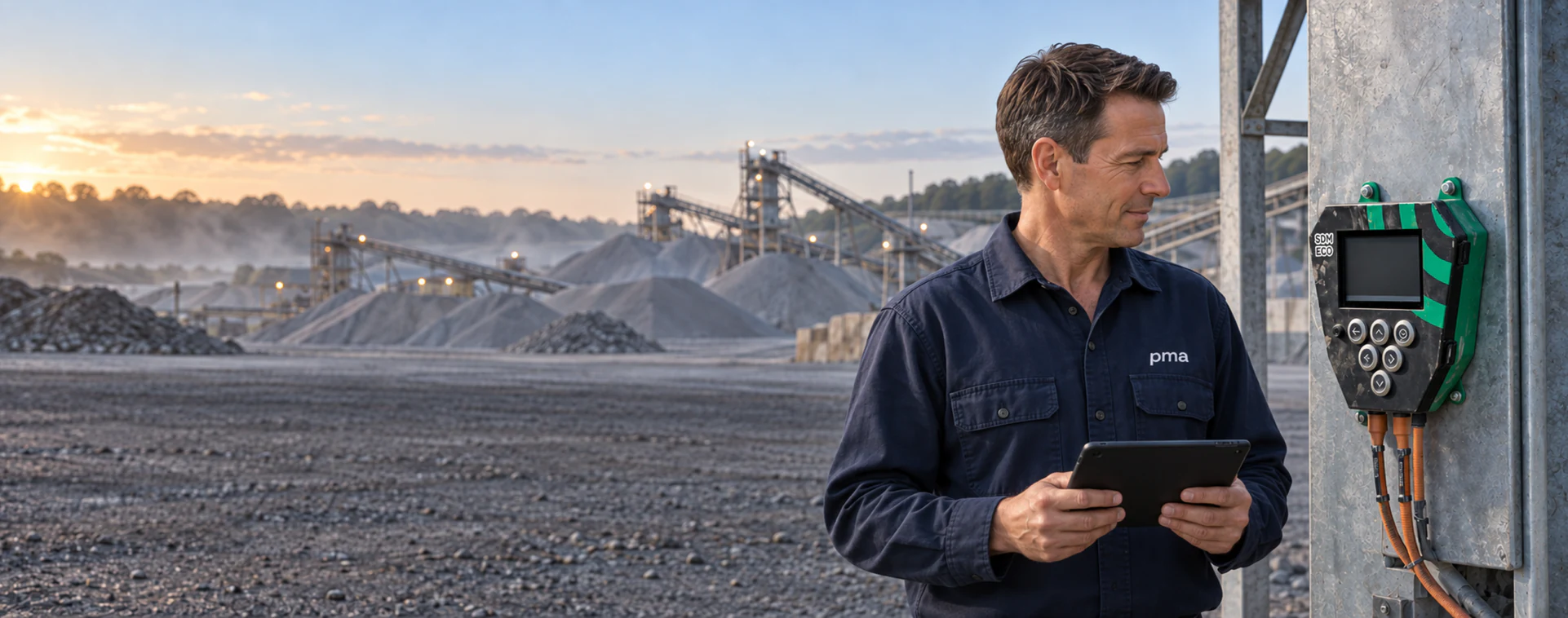
See the measurement in its process context
Application planning includes the surrounding process, safe access, representative sampling and verification—not only the analyser itself. PMA reviews these conditions together before recommending a measurement arrangement.
Three decisions for a limestone slurry duty
These choices determine whether the installed reading represents the process.
Name the stream
Distinguish feed, product, recycle, transfer and dosing slurries. Record the source, destination, expected density range, particle size and liquid composition.
Choose representative hydraulics
Review velocity, pipe orientation, settling risk, pump position, bends, valves, air entrainment and whether the pipe remains full in every operating state.
Define verification
Specify where and how reference samples will be taken, how quickly they will be analysed, and how process changes will be aligned with the online signal.
Limestone slurry density measurement pathway
- Define the objective. Link density to a named operating or quality decision.
- Characterise the slurry. Record density range, solids, liquid, particle size, temperature and gas risk.
- Survey candidate locations. Check full-pipe condition, flow profile, access and isolation.
- Select the fitting. Match installation hardware to the actual pipe and abrasion duty.
- Commission across conditions. Compare flush water, normal slurry and relevant operating changes with reference samples.
- Retain the evidence. Keep configuration, sample and maintenance records for later review.
Evidence to collect
Collect paired density and reference results with flow, temperature, pump state, production rate and sample time. Note visible air, foam, settling, scaling or changes in stone source. These contextual records help separate a process change from an installation or sampling issue.
Limits, compatibility and safety
A density meter does not replace independent flow, pressure, level or process-safety instrumentation. Poorly mixed or partially filled pipework can make a convenient location unrepresentative. Abrasion, scale and changing material properties must be included in inspection and validation plans.
Frequently asked questions
Can the meter report limestone solids concentration?
It may be possible to calculate solids concentration from slurry density when solid and liquid densities and composition are known. The calculation basis and units must be agreed and validated.
What causes unstable readings?
Entrained air, variable fill, settling, pulsating flow, abrupt composition changes and an unrepresentative sample point are common investigation areas.
Is a horizontal pipe suitable?
It can be, but settling and full-pipe condition need review. The best orientation and fitting depend on velocity, particle behaviour, access and the manufacturer installation requirements.
How often should the result be checked?
Set the verification frequency from process variability, consequence and evidence. Include more frequent checks during commissioning and after maintenance or material changes.
Sources and engineering review scope
PMA will review the stream definition, slurry properties, hydraulics, pipe details, installation access, sample method and required output. This page is application guidance, not a substitute for a site survey, chemical compatibility review, risk assessment or manufacturer-approved configuration.
Related analyser range
Review the 9600 Series and SDM ECO options for continuous ultrasonic slurry density measurement.
View the relevant analyser range.
Define your limestone slurry measurement point
Share the process flow diagram, pipe details, slurry range, particle information and sample method for an engineering review.