Dredging Production and Mass Flow Measurement
Combine validated slurry density and flow measurements to calculate transported material within a clearly defined reporting and uncertainty boundary.
Treat production as a calculation, not a single sensor reading
Density and volumetric flow can be combined to estimate transported slurry and solids. Slurry volume, wet slurry mass and dry-solids mass are different results, and none should be labelled as in-situ volume removed from the bed. Define the output, units and reporting boundary before calculating production.
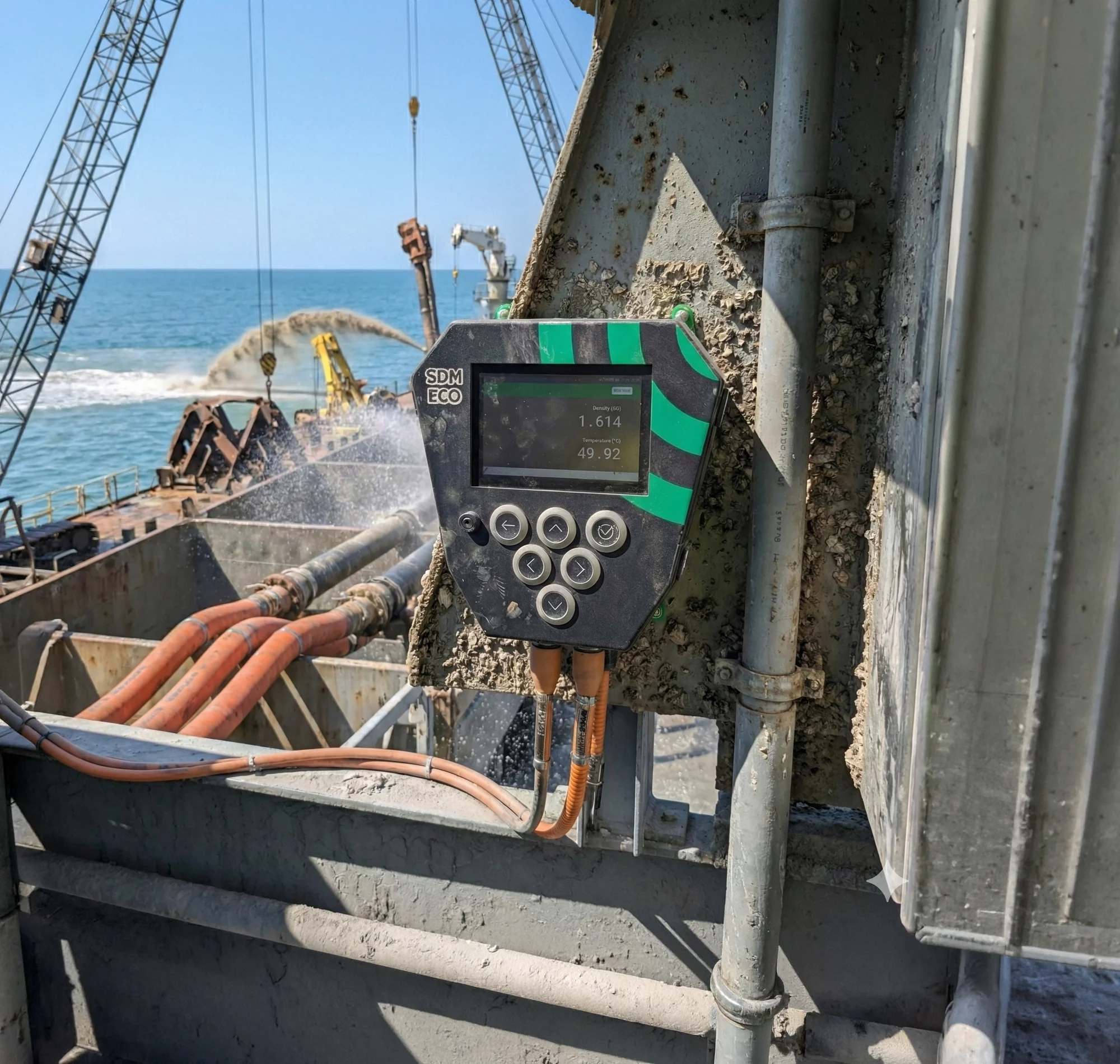
Representative SDM ECO application image; the complete measurement system also requires suitable flow and process data.
Define the production calculation
For a simple liquid-and-solids mixture, let ρm be measured slurry density, ρl carrier-liquid density and ρs effective solids density, all in kg/m³. Let Q be aligned volumetric slurry flow in m³/h.
Solids volume fraction: Cv = (ρm − ρl) / (ρs − ρl).
Solids mass fraction: Cw = Cv × ρs / ρm.
Wet slurry mass rate: Q × ρm / 1,000, in tonnes/hour.
Dry-solids mass rate: Q × Cv × ρs / 1,000, in tonnes/hour.
Cv and Cw are fractions: multiply by 100 for percentages. These relationships assume a representative two-phase mixture with known component densities and compatible density and flow measurements. Use the existing density and percent-solids calculator to explore the inputs. The review requirements below define the evidence needed before using a calculated result.
Measurand and units
Define slurry density, solids concentration, dry-solids rate, wet mass, volume or another required output.
Flow measurement
Confirm flowmeter principle, location, range, zero stability and time alignment with density.
Material assumptions
Document liquid density, solids density, particle and composition variability and any laboratory basis.
Reporting boundary
State whether the result is operational guidance, project accounting, contractual evidence or environmental reporting.
A practical SDM ECO review pathway
Hypothetical worked example. Suppose slurry density is 1,300 kg/m³, carrier-liquid density is 1,000 kg/m³, effective solids density is 2,650 kg/m³ and volumetric flow is 1,000 m³/h.
Cv = (1,300 − 1,000) / (2,650 − 1,000) = 0.1818, or 18.2% solids by volume. Cw = 0.1818 × 2,650 / 1,300 = 0.3706, or 37.1% solids by mass. Wet slurry throughput is 1,300 tonnes/hour; dry-solids throughput is approximately 481.8 tonnes/hour.
These are illustrative inputs under the simple model, not measured site results or expected instrument performance. A freshwater density must not be assumed for seawater. Check mixed sediment, dissolved material, temperature, entrained air and any difference between solids and liquid velocities. Then follow the review sequence below to define a testable duty.
1. Write the equation
Agree every input, unit and assumption.
2. Align instruments
Place and time-align density and flow measurements.
3. Quantify uncertainty
Validate inputs across the operating range.
4. Govern reporting
Control data quality, exclusions, records and recalculation.
Where the measurement can add value
The signal is useful only when it supports a defined operational decision and remains inside a validated measurement boundary.
Potential value
A validated calculation can support production trends, pipeline performance review and comparison of operating states.
Important limitations
A precise display is not proof of an accurate production figure. Sensor uncertainty, representative sampling, component densities, solids slip and time alignment all affect the result. Water addition, branches and transport delay must be accounted for. Calculated transported material does not independently validate contractual quantities or in-situ removed volume.
Sources and application boundary
The sources below define the general dredging method and measurement context. Final suitability depends on the actual slurry, pipe hydraulics, installation point, operating range and validation evidence for the project.
Continue exploring
Return to the dredging application library, explore the density and percent-solids calculator, review the installation guide, or see the SDM ECO product page.
For intervals, gaps, transport delay and traceable acceptance records, use PMA’s dredging density and flow reconciliation guide. For measurement terminology, read dredging measurement explained.
Let’s talk about your application.
Speak to the PMA team about your instruments, reagents or service requirements. Tell us what you need, and we’ll help you find the right next step.
- Advice for your application. Find the right instruments, sensors and chemical reagents for your process.
- Practical service support. Discuss commissioning, calibration, maintenance or an instrument issue with our team.
- Clear next steps. Ask a technical question or request a callback, with your site and measurements in mind.
- An enquiry, not a mailing list. Your details are used to respond to you. You won’t be added to a marketing database.
Prefer to speak with us?
Call 01484 843 708You can also email sales@pma.uk.com.
Need a faster response?
Share a few details about your application now, and we can help you find the right next step sooner.
Tell us how we can help
Share your requirements below. All fields are required.
Your enquiry goes directly to our team. Your details are used to respond to you, and you won’t be added to a marketing database. Read our privacy policy.