Cutter Suction Dredger Density Monitoring
Assess a non-nuclear density signal for cutter-head excavation and hydraulic transport, with the measurement point tied to a stable pipeline duty.
Relate the density trend to excavation and transport conditions
A cutter suction dredger loosens material mechanically and transports the resulting slurry through a pipeline. A useful SDM ECO duty should identify whether the measurement supports cutter operation, dilution control, pump loading, pipeline transport or production evidence.
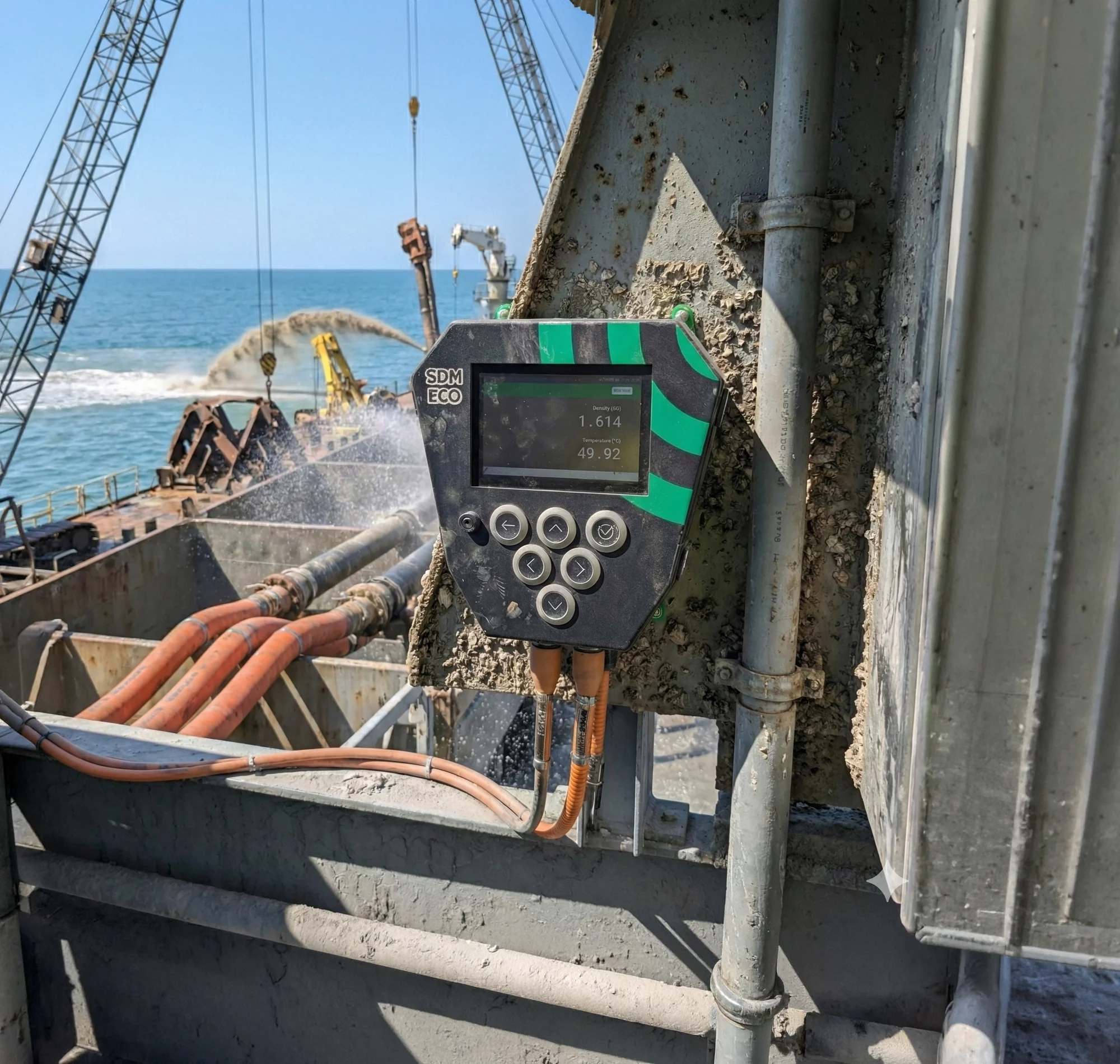
Representative SDM ECO dredging installation image; it is not a project-specific installation claim.
Screen the cutter-suction application
The review connects the dredging method to one defined instrument location.
Excavation context
Record material variability, cutter conditions, water depth and expected changes between soil layers.
Candidate location
Compare suction and discharge lines for pressure, fill, access, abrasion, entrained air and maintenance.
Related variables
Use pump speed, vacuum or pressure, flow and production events to interpret the density trend.
Validation plan
Cover water, normal production, transitions and representative high-loading states with aligned references.
A practical SDM ECO review pathway
Use the sequence to move from a broad dredging requirement to a defined, testable measurement duty.
1. Define the decision
Name the action or report that needs the density signal.
2. Select the line
Choose a stable, fully flooded suction or discharge duty.
3. Map variability
Document material, velocity, air and production changes.
4. Commission safely
Validate before control or contractual reporting use.
Where the measurement can add value
The signal is useful only when it supports a defined operational decision and remains inside a validated measurement boundary.
Potential value
Continuous density can help operators see loading changes and, with flow, support production analysis and pipeline management.
Important limitations
The sensor does not replace soil characterization, flow measurement, pump protection or independent navigation and safety systems.
Sources and application boundary
The sources below define the general dredging method and measurement context. Final suitability depends on the actual slurry, pipe hydraulics, installation point, operating range and validation evidence for the project.
Continue exploring
Return to the dredging application library, review the installation and commissioning guide, or see the SDM ECO product page.
Let’s talk about your application.
Speak to the PMA team about your instruments, reagents or service requirements. Tell us what you need, and we’ll help you find the right next step.
- Advice for your application. Find the right instruments, sensors and chemical reagents for your process.
- Practical service support. Discuss commissioning, calibration, maintenance or an instrument issue with our team.
- Clear next steps. Ask a technical question or request a callback, with your site and measurements in mind.
- An enquiry, not a mailing list. Your details are used to respond to you. You won’t be added to a marketing database.
Prefer to speak with us?
Call 01484 843 708You can also email sales@pma.uk.com.
Need a faster response?
Share a few details about your application now, and we can help you find the right next step sooner.
Tell us how we can help
Share your requirements below. All fields are required.
Your enquiry goes directly to our team. Your details are used to respond to you, and you won’t be added to a marketing database. Read our privacy policy.