Colemans Farm Quarry Slurry Density Monitoring Review
A site-specific review framework for continuous density measurement around the Colemans Farm sand-and-gravel wash plant.
Non-nuclear density monitoring for Colemans Farm Quarry in Essex
Colemans Farm Quarry near Witham, Essex uses washing, scrubbing, cyclones, pumps and lagoons to process sand and gravel. The SDM ECO is well suited to continuous non-nuclear density monitoring on a representative pumped slurry line, helping operators follow solids loading through washing and water-recovery duties. PMA would confirm the most useful point against the current flowsheet.
Application note: This guide uses published process information to identify where SDM ECO measurement may be useful. PMA would confirm the current process, pipe conditions and calibration range before recommending an installation.
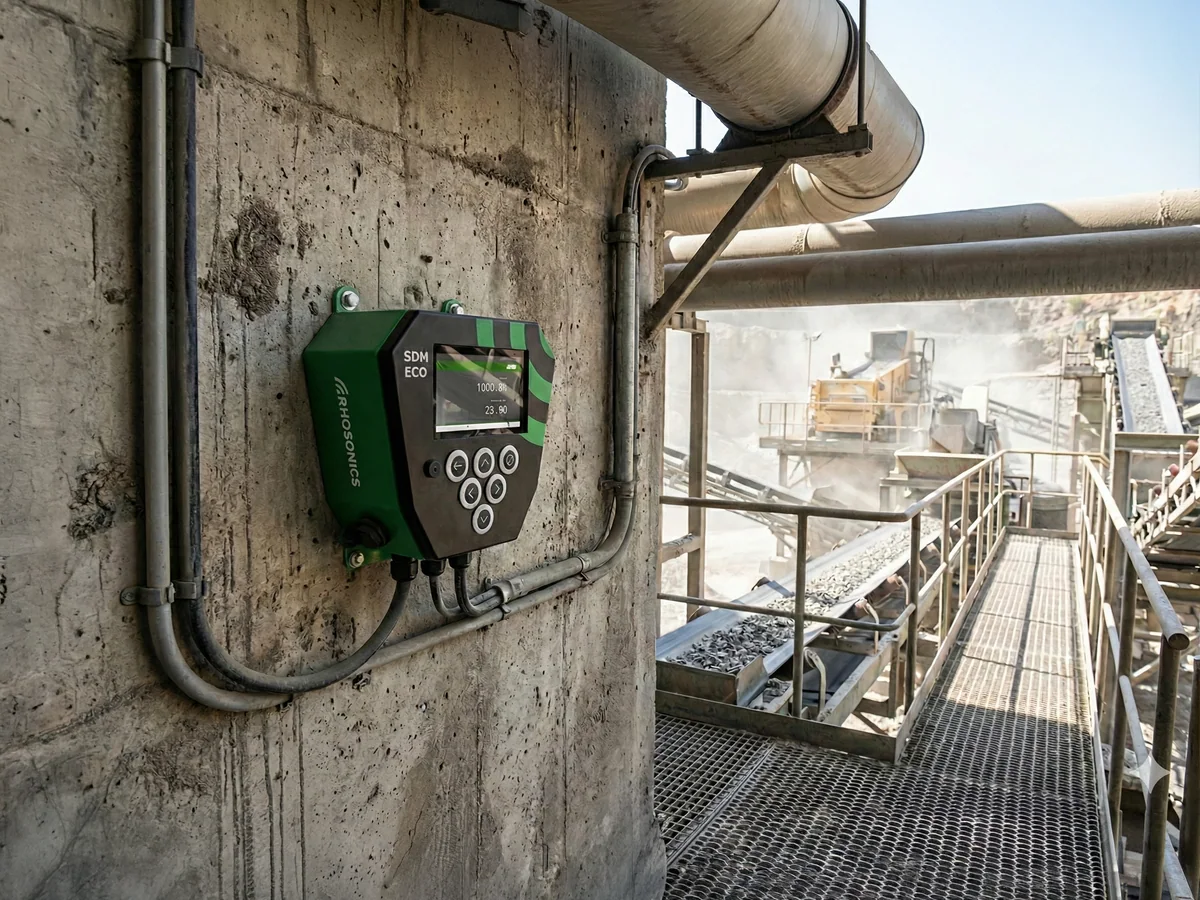
Representative Rhosonics quarry application image. It is not presented as a photograph of Colemans Farm Quarry.
Quarry process and SDM ECO opportunities
The strongest opportunity is where a stable, fully flooded line carries information operators can act on.
Local process and material
The published plant processes sand and gravel, producing clean graded aggregates and separate coarse and fine sand products.
Where SDM ECO can help
Potential review points include pumped sand feed, cyclone feed, dirty-water return or another pressurised line where density relates to classification or water balance.
What to confirm
Record the present pump duty, pipe details, flow range, stone and sand split, lagoon operation, water additions and paired sample results.
Application considerations
A lagoon or open-channel value cannot be inferred from a pressurised pipe reading. Air, changing feed grading and intermittent flow must be assessed.
A practical SDM ECO review pathway
These four steps show how PMA would assess a potential SDM ECO duty, from selecting the process stream through to validating the measurement against representative site data.
1. Select the circuit
Choose one pumped stream rather than the whole wash plant.
2. Link it to control
Define the adjustment or diagnostic question the value supports.
3. Record variability
Cover feed split, water changes, start-up and low-flow states.
4. Commission carefully
Use matched samples and process records before operational use.
Where continuous density may add value
A continuous trend may reveal feed or dilution changes sooner than periodic sampling and support investigation of cyclone loading, sand split or recirculated-water conditions.
What PMA would verify on site
PMA would confirm a safe sensor location, full pipe, representative mixing, abrasion exposure, isolation and whether the proposed signal aligns with the plant’s existing control philosophy.
Sources and application guidance
Public facts used for this site profile are linked below. Process descriptions can change, so PMA would confirm the current flowsheet, operating range and measurement objective directly with the operator before proposing hardware.
Continue exploring
Return to the UK quarry application library, review mining slurry measurement guidance, or see the SDM ECO product page.
To contact us, or to request a callback, simply use the form below and we will promptly get back to you.
We greatly value all of the inquiries which our products and services generate and we are very confident that we will have the right solution available for you at the first point of contact when you reach our experienced team of engineers.

Estamos aqui para ajudar.
Seja para solicitar um retorno de chamada ou para esclarecer uma dúvida altamente técnica, nossa equipe de especialistas está sempre à disposição. Nosso foco sempre foi oferecer um atendimento ao cliente de excelência.